es2624 — Organisation Release
"Ausgerechnet! Unser Universum" at the ESO Supernova
7 August 2026
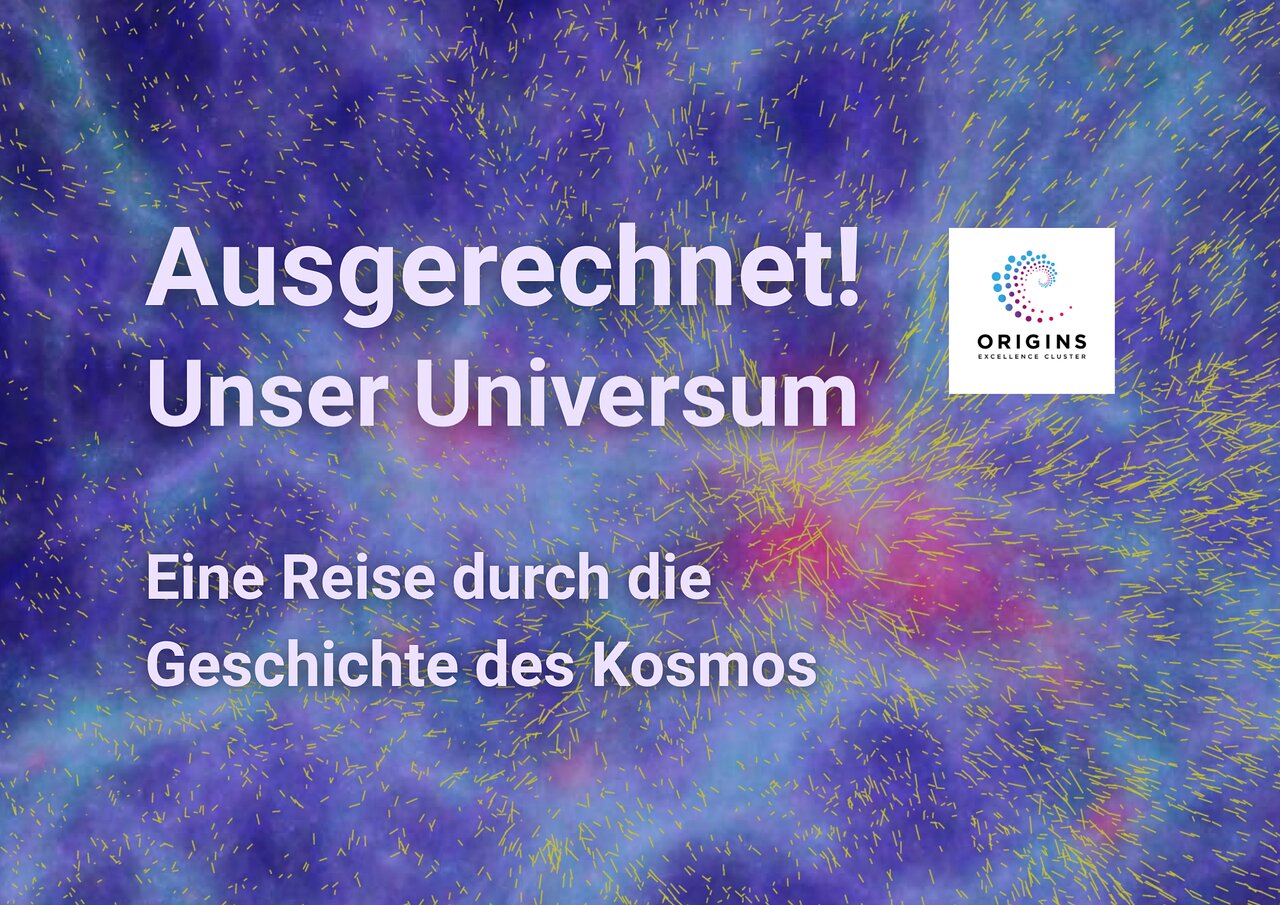
The planetarium show, developed jointly with researchers from the Excellence Cluster ORIGINS, will become part of the ESO Supernova’s regular programme starting in September 2026
What happened after the Big Bang? How did the first galaxies, stars, and the large-scale structures of the cosmos form? And how do researchers reconstruct the evolution of the Universe over the course of 13.8 billion years? The planetarium show Ausgerechnet! Unser Universum explores these questions; it will be shown regularly at the ESO Supernova planetarium starting in September.
This approximately 30-minute fulldome production was originally created in 2019 for the Deutsches Museum planetarium. It was developed through close collaboration between the Deutsches Museum, the former Excellence Cluster "Universe", and its successor, ORIGINS. For the ESO Supernova, the show has undergone technical revisions and was adapted for the facility's planetarium.
A journey through the history of the cosmos
Narrated by astrophysicist and science journalist Prof. Dr. Harald Lesch, the show takes the audience on a journey through the history of the universe and its exploration. From Galileo Galilei’s first telescopic observations to modern cosmology, it illustrates how our view of the cosmos has evolved.
At the heart of the show are scientific simulations calculated on the high-performance computer at the Leibniz Supercomputing Centre (LRZ) in Garching. The resulting visualisations allow the audience to experience the formation of galaxies, galaxy clusters, and the Universe's largest structures under the planetarium dome.
Billions of years on the supercomputer
"Many processes in the Universe take billions of years and cannot be observed directly," says Prof. Dr. Klaus Dolag of the University Observatory at Ludwig-Maximilians-Universität München (LMU) and the Excellence Cluster ORIGINS. "Simulations allow us to trace this evolution and compare it with astronomical observations. In the planetarium, scientific data can be experienced in a unique way."
The visualisations shown are based, among other things, on the Magneticum Pathfinder project, which Klaus Dolag leads at LMU Munich and the ORIGINS Cluster of Excellence. The simulations model the evolution of the universe from the first structures following the Big Bang to the present day. They help researchers better understand the roles of ordinary matter, dark matter, and dark energy.
Research under the dome
“We are delighted to include this impressive production in the ESO Supernova programme,” says Tania Johnston, Head of the ESO Supernova. “The show combines cutting-edge research with a compelling visitor experience, revealing how scientists explore our universe.”
In addition to the evolution of the cosmos, the production also showcases the scientific landscape in Munich and Garching—ranging from the Wendelstein Observatory, the Max Planck Institutes, and the ORIGINS Cluster of Excellence to the European Southern Observatory (ESO).
An impossible journey through space and time
"I’ve never been a tour guide before—and then to lead such a fantastic journey right off the bat. Thanks to the work of my colleagues in Munich and Garching—and their wonderful simulations and observations—we can embark on an incredible tour through space and time," says Harald Lesch.
Ausgerechnet! Unser Universum will be shown regularly at the ESO Supernova planetarium starting in September. The show invites visitors to experience the origin and evolution of the cosmos—based on scientific data—under the planetarium dome. The show is aimed at audiences aged 10 years and up. Before the 30 minute film, there will be a live introduction to the current night sky, making the duration of the show ca. 1 hour. Tickets cost 6,50 Euro per person and can be booked online now.
Links
- Find out more about Ausgerechnet! Unser Universum and book your tickets
- ESO Supernova planetarium programme
- Plan your visit
- Subscribe to our newsletter
- Follow us on Instagram
Contacts
ESO SUPERNOVA
Tel: 08932006900
Email: supernova@eso.org